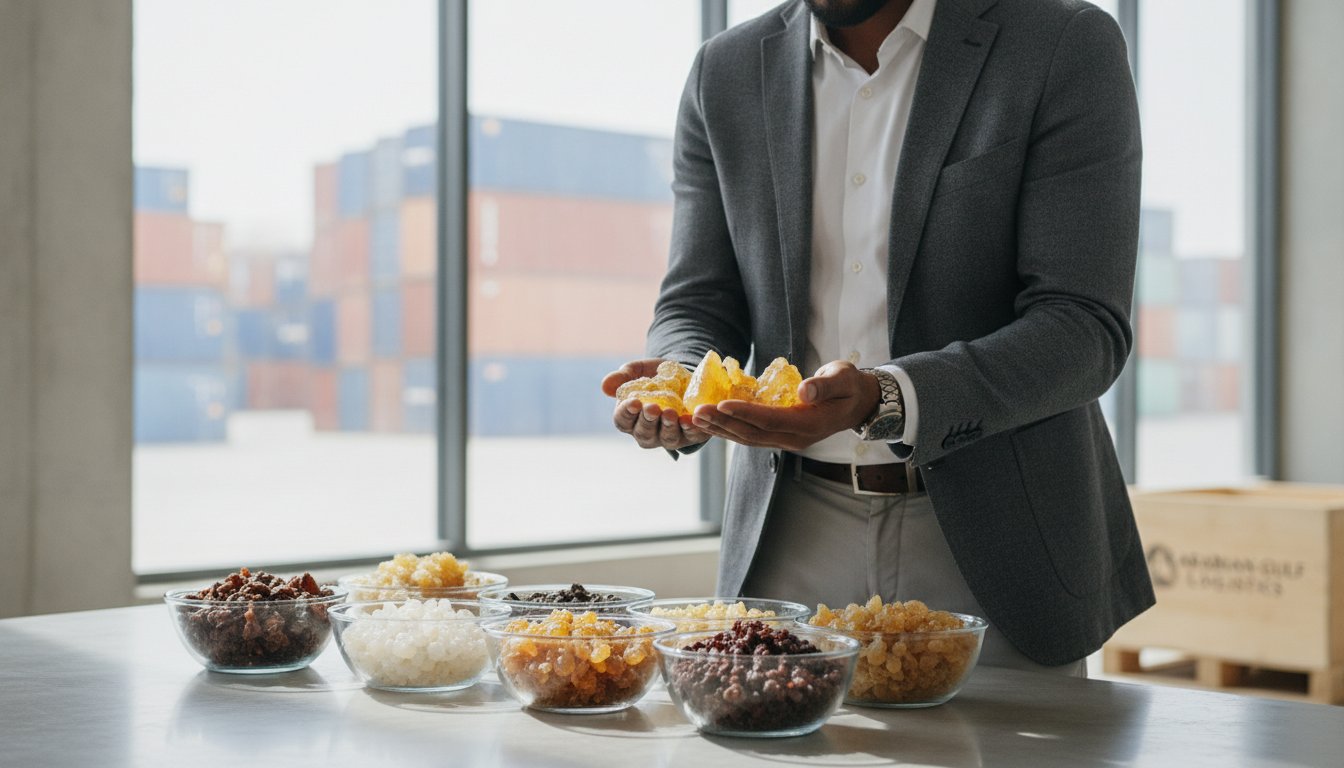
If your procurement strategy relies on general importers, you're likely paying a premium for resin that has passed through three sets of hands before it reaches your facility. This isn't just a cost issue. It's a transparency crisis that leaves your brand vulnerable to adulterated batches and inconsistent quality. Finding a dependable incense resin bulk supplier shouldn't feel like a gamble with your brand's reputation.
You probably recognize that securing high-grade Boswellia and Commiphora is becoming more complex as global demand for natural products surges toward an expected $26.27 billion by 2035. It's frustrating to receive a shipment only to find synthetic fillers or a scent profile that doesn't match your previous order. You need a partner that understands the botanical complexities of the product and the logistical precision required for international trade.
In this guide, you'll discover how to evaluate suppliers, verify resin purity, and secure a direct, ethical supply chain for your business. We'll examine the critical steps for navigating the July 2026 EU fragrance allergen regulations and show you how to reduce procurement costs by cutting out unnecessary middlemen. By the end, you'll have a clear framework to ensure your brand remains aligned with sustainable harvesting practices and premium quality standards.
Key Takeaways
- Learn to differentiate between specific botanical species and verify the directness of your supply chain to ensure absolute product authenticity.
- Discover how sourcing directly from the origin preserves resin freshness, providing significantly higher yields for essential oil distillers and wellness brands.
- Master the systematic grading criteria used by a premium incense resin bulk supplier to evaluate shipments based on tear size, color, and clarity.
- Understand the critical importance of ethical harvesting in protecting the long-term viability of vulnerable Boswellia and Commiphora populations and your brand’s integrity.
- Identify the logistical advantages of partnering with a direct-at-source provider to secure a stable, transparent, and cost-effective inventory for global distribution.
Evaluating an Incense Resin Bulk Supplier: Key Selection Criteria
Professional procurement of resins like Frankincense and Myrrh requires more than just comparing price sheets. When you select an incense resin bulk supplier, you're investing in a relationship that dictates your product's chemical profile and your brand's ethical standing. High-grade resins are essentially an aromatic biotic material, and their quality is inextricably linked to their journey from the tree to your warehouse. A supplier who lacks a clear view of this journey cannot guarantee the purity your customers expect.
Consistency is the primary challenge for professional buyers. You need to ensure that the resin size, colour, and aromatic profile remain uniform across every shipment. This level of precision is only possible when a supplier maintains strict control over their grading processes and understands the botanical distinctions between species like Boswellia carterii and Commiphora myrrha. Without this expertise, you risk receiving batches that fail to meet your specifications.
Supply Chain Transparency and Origin
Knowing the specific region of origin is vital for maintaining chemical consistency in your product line. For instance, resins sourced from Somaliland possess a specific terpene profile that differs significantly from those found in other regions. If a supplier cannot name the specific harvesting area or species, you're likely dealing with "grey market" resins. These materials often lack clear origin data and are frequently blended with inferior harvests to mask impurities or stretch volume. Direct sourcing eliminates these variables. By bypassing middlemen, you ensure the resin hasn't sat in sub-optimal conditions at multiple transit points. This preserves the delicate essential oils and prevents the degradation that occurs during extended storage in humid or unregulated environments.
Scalability and Volume Consistency
A reliable partner must demonstrate the capacity to handle multi-kilogram monthly demands without sacrificing quality. This requires a deep understanding of seasonal harvest cycles. In the resin trade, supply isn't a constant tap; it's a natural rhythm influenced by local climate conditions and traditional tapping schedules. You should be wary of "rock bottom" pricing. Often, these low rates indicate a supplier is liquidating old, degraded stock or lacks the infrastructure to provide a stable, long-term supply. Professional buyers need documentation regarding harvesting rights and ethical practices as a baseline. In 2026, these records aren't just paperwork; they're proof of a supplier's commitment to the long-term viability of the species. A steady and transparent partner respects these ancient traditions while operating a modern, efficient, and globally-minded business.
Direct-from-Source vs. General Importers: Why Origin Matters
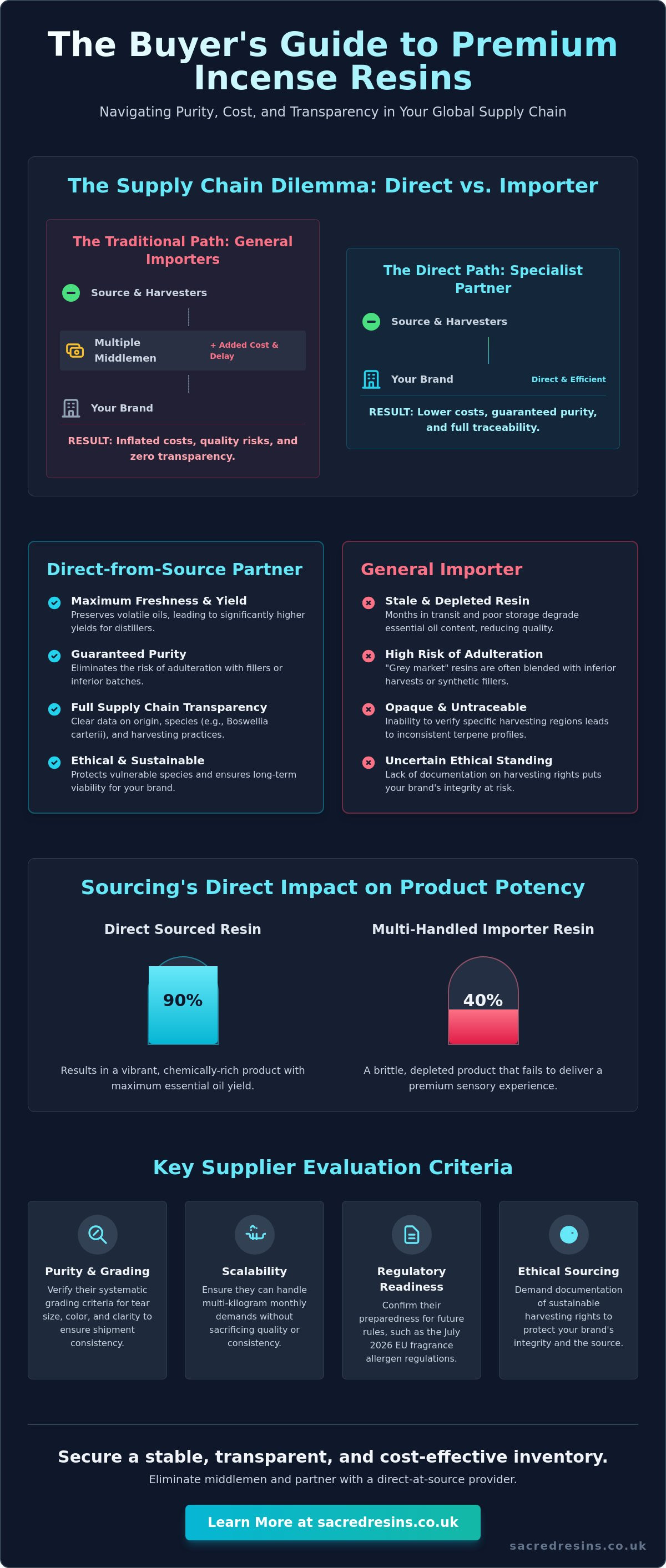
Choosing a general importer over a direct-from-source partner introduces layers of opacity that can compromise your final product. When you work with a general incense resin bulk supplier, you're often paying for a supply chain that includes multiple secondary traders. Each entity adds a markup while the resin's quality slowly diminishes through repeated handling. These hidden costs aren't just financial. They manifest as lost aromatic potency and increased handling fees that provide zero value to your brand or your customers.
Freshness is a critical metric for professional buyers, yet it's often ignored by general wholesalers. For essential oil distillers and wellness brands, the "yield" of a resin is entirely dependent on its oleoresin content. This content begins to evaporate the moment the resin is harvested. By the time a shipment reaches a local importer's warehouse, it may have spent months in transit or sitting in unregulated storage. This delay results in a brittle, chemically depleted product that fails to deliver the vibrant sensory experience your clients expect.
The Risks of Middlemen in the Resin Trade
The resin trade is prone to adulteration when oversight is lax. Middlemen often mix high-grade tears with lower-quality siftings or even synthetic fillers to maintain their margins. Beyond physical purity, the "stale resin" problem is a significant concern. Resins stored in regional warehouses for extended periods lose their volatile oils, resulting in a flat scent profile. This storage degradation kills the aromatic potency. Additionally, secondary trading layers create price volatility. Each entity in the chain reacts to market shifts independently, making it difficult for you to forecast procurement costs with any accuracy.
The Somaliland Advantage: Freshness and Potency
Sourcing directly from Hargeisa, the logistical heart of the trade, offers a distinct advantage in freshness. By accessing the 2026 harvest cycles directly, you ensure the resin retains its maximum oleoresin content. Local sorting expertise in Somaliland ensures that grade-A material is identified and preserved at the point of origin, rather than being diluted in a generic export batch. This proximity to the source is essential for maintaining Sustainable Sourcing for Wellness and Liturgical Brands, as it allows for direct verification of harvesting methods and tree health.
Direct sourcing preserves the delicate terpene profile of premium frankincense resin by minimizing the time between the tree and the shipping container. When you eliminate the detour through third-party warehouses, you receive a product that is chemically vibrant and aromatically superior. For businesses that value this level of integrity, exploring direct wholesale options is the most effective way to secure a stable and potent inventory.
Verifying Purity and Grading in Wholesale Shipments
Resin grading is not a subjective art; it's a systematic classification based on tear size, colour, and clarity. For a professional buyer, understanding these metrics is the only way to ensure that the value of a shipment aligns with its cost. When you partner with a reputable incense resin bulk supplier, they should provide clear, standardized data that removes the guesswork from your procurement process. These classifications dictate everything from the aromatic profile to the eventual yield in manufacturing or distillation.
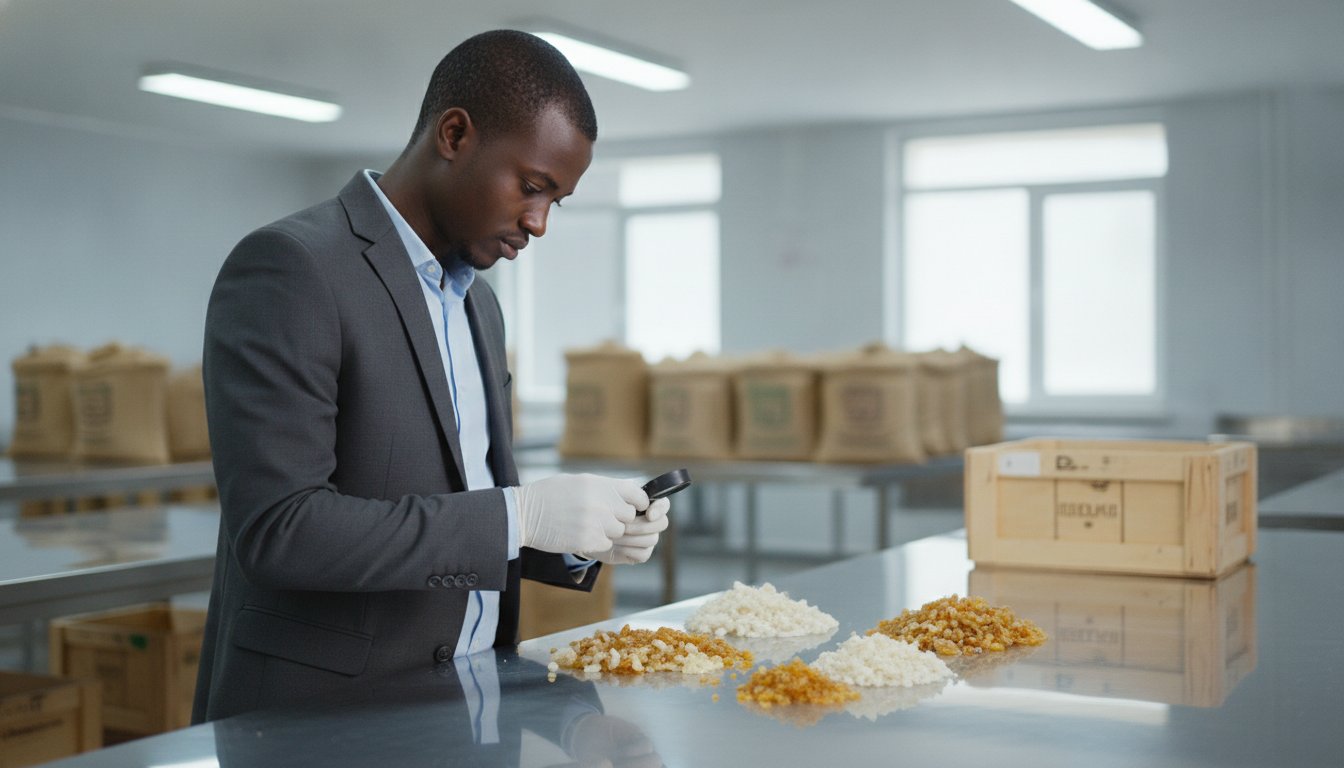
Visual indicators offer the first line of defense against sub-standard material. High-grade frankincense is characterized by distinct "tears" that exhibit a translucent, crystalline structure. In contrast, siftings and powders are often the byproduct of handling and transit. While these lower formats are useful for specific industrial applications, they're more susceptible to oxidation and adulteration. Distillers, in particular, must look beyond aesthetics to moisture and oil content benchmarks. If the moisture content is too high, you're paying for weight that adds no value; if it's too low, the essential oils have likely already dissipated.
Understanding Resin Grade Classifications
The industry generally divides harvests into three primary tiers. Grade A, consisting of large, clean tears, is the gold standard for liturgical use and high-end retail packaging where visual purity is paramount. Grade B and C involve smaller, pea-sized tears. These are ideal for grinding or small-batch incense production where the visual uniformity of the raw material is less critical than its chemical integrity. Finally, siftings and powder are utilized in large-scale manufacturing and industrial distillation. While cost-effective, these formats require rigorous testing to ensure they haven't been "stretched" with inert fillers or bark dust.
Physical and Chemical Purity Testing
A simple "burn test" remains one of the most effective ways to identify synthetic additives or bark contamination. Pure resin will melt and bubble, releasing a clean, characteristic aroma. Adulterated batches often char, produce acrid black smoke, or leave behind a heavy, non-resinous ash. You can also perform a basic water test to detect gum Arabic, a common filler. While pure resins create a milky emulsion in water due to their natural gum content, many synthetic fillers will either dissolve completely or sink without changing the water's opacity. For large-scale procurement, a Certificate of Analysis (CoA) is non-negotiable. This document provides a laboratory-verified breakdown of the batch’s chemical composition, ensuring the bark-to-resin ratio meets your specific professional standards.
Sustainable Sourcing for Wellness and Liturgical Brands
Ethical sourcing is no longer a peripheral concern; it's a foundational requirement for any brand that values long-term supply chain security. As an incense resin bulk supplier, we recognize that the health of the Boswellia sacra and carterii populations directly dictates the viability of your future product lines. Over-harvesting isn't just an ecological tragedy. It's a business risk that leads to dwindling harvests, erratic pricing, and compromised resin quality. When a tree is stressed by excessive tapping, the resin it produces often lacks the complex aromatic profile required for premium applications.
Integrating sustainability stories into your brand's marketing is essential for connecting with the 2026 wellness consumer. These buyers are increasingly sophisticated and demand transparency regarding the botanical origin and the ethical footprint of their purchases. By demonstrating a commitment to tree health and harvester welfare, you elevate your product from a mere commodity to a steward of ancient heritage. This alignment with ethical standards protects your brand’s reputation and ensures a stable, high-quality inventory for decades to come.
Ethical Harvesting Practices in the Horn of Africa
Traditional tapping methods, passed down through generations, respect the natural limits of the tree. These methods involve making a limited number of shallow incisions and allowing the tree to heal completely between seasonal harvests. In contrast, aggressive modern practices often involve over-tapping, which weakens the tree's immune system and leaves it vulnerable to pests. Ensuring sustainable resin harvesting requires strict adherence to mandatory rest periods. Sacred Resins actively monitors tree health within our partner forests in Somaliland, ensuring that each tree is given the time it needs to recover. This methodical approach guarantees that the resin you receive is produced by healthy, vibrant trees that will continue to yield for generations.
Fair Trade and Community Impact
There's a direct, functional link between fair trade and the physical quality of your wholesale shipments. When harvesters receive a living wage, they have the economic stability to focus on precise, meticulous sorting at the source. This results in cleaner resin with fewer bark inclusions and a more consistent grade across the batch. Community stability is the bedrock of supply chain reliability. By supporting local infrastructure in Hargeisa through direct trade, we help create a resilient ecosystem that can withstand regional fluctuations. Supporting the people behind the harvest is the most effective way to ensure the long-term viability of your product line. To secure a supply that reflects these values, you can view our ethical wholesale collections and partner with a supplier committed to the longevity of the trade.
Scaling Your Inventory with Sacred Resins’ Bulk Solutions
Sacred Resins operates as a direct bridge from the harvest lands of Somaliland to the global market. We manage the journey. As a specialized incense resin bulk supplier, our team oversees the entire process from the forests surrounding Hargeisa to your facility. This direct oversight ensures the integrity of our Premium Frankincense and Myrrh Resins remains uncompromised by secondary handling. Whether you're supplying a cathedral, distilling essential oils, or stocking a retail chain, our operations are built to scale with your specific volume requirements.
We've refined a procurement process that prioritizes professional certainty. It begins with rigorous sample verification, allowing your technical teams to confirm the botanical profile and oleoresin content before you commit to larger volumes. Once approved, we move to pallet-level shipping, utilizing professional sorting and custom packaging that meets the specific needs of your industry. This methodical approach eliminates the quality drift often seen with general importers who lack a direct connection to the source. It's about providing a steady and transparent partnership that respects ancient traditions while operating a modern business.
Streamlined Global Logistics from Hargeisa
International shipping for aromatic resins requires precise documentation and logistical expertise. For 2026 bulk orders, we account for evolving regulatory landscapes, including the July 2026 EU fragrance allergen labeling requirements under Regulation (EU) 2023/1545. Our team manages the complexities of air and sea freight to ensure your inventory arrives within predictable lead times. For US-bound shipments, we provide the necessary HS code data (3307.41) and documentation to facilitate smooth customs clearance. We help you navigate relevant fees like the Merchandise Processing Fee or Harbor Maintenance Fee. This transparency prevents the unexpected delays that often plague grey market acquisitions.
Custom Bulk Pricing and Procurement
We offer tiered pricing structures designed to support both growing wellness brands and established industrial distillers. These tiers cover everything from multi-kilogram batches to metric tonne orders, ensuring your unit costs decrease as your volume expands. Establishing a long-term supply contract provides the greatest price stability. It shields your brand from the volatility of the secondary resin market. This partnership transforms a simple transaction into a strategic asset for your business. To begin a consultation regarding your specific volume needs, contact our Hargeisa team for a wholesale resin quote.
Securing Your Supply Chain for 2026 and Beyond
The global market for aromatic resins is shifting toward a model that rewards transparency and directness. As we've explored, the highest ROI in procurement doesn't come from the lowest price point, but from the elimination of middlemen who dilute quality and obscure botanical origin. By prioritizing direct-from-source partnerships, your brand can confidently navigate the expanding regulatory requirements of 2026 while ensuring a consistent, potent inventory. Choosing a reliable incense resin bulk supplier is a strategic decision that safeguards your product's chemical integrity and your company's ethical reputation.
Sacred Resins provides the infrastructure you need to scale with professional certainty. Our operations are directly sourced from Somaliland harvesters and feature specialized sorting for distillers and liturgical use. With worldwide shipping managed directly from Hargeisa, we provide the logistical precision required for modern manufacturing and international religious institutions. We're here to serve as your knowledgeable guide and trusted bridge to the world's finest Frankincense and Myrrh.
Take the next step in professionalizing your procurement and protecting your brand's future. Secure Your Direct Supply of Premium Bulk Resins and build a foundation of quality that will sustain your business for years to come.
Frequently Asked Questions
What is the minimum order quantity for an incense resin bulk supplier?
Minimum order quantities vary depending on the resin variety and the supplier's logistical capabilities, typically starting from a few kilograms for boutique orders. For larger operations, suppliers often provide pallet-level MOQs that cater to industrial distillers and high-volume retailers. As a specialized incense resin bulk supplier, we offer scalable solutions that allow professional buyers to secure consistent inventory while benefiting from tiered pricing structures that reward higher volume commitments.
How can I tell if bulk frankincense resin has been adulterated?
You can identify adulterated resin by performing a burn test or a water test to check for synthetic fillers or non-resinous additives. Pure resin melts and bubbles with a clean, characteristic aroma, whereas adulterated material often chars, produces acrid black smoke, or leaves a heavy ash residue. Additionally, you should inspect the batch for an excessive bark-to-resin ratio or the presence of gum Arabic, which is frequently used to artificially increase weight.
Why is direct sourcing from Somaliland better than buying from an importer?
Direct sourcing preserves the resin's oleoresin content and aromatic potency by eliminating the delays and degradation associated with secondary warehousing. When you bypass general importers, you access the current harvest cycle directly from the source in Hargeisa rather than buying stale inventory that has sat in regional hubs. This transparency ensures your resin hasn't been blended with inferior "grey market" materials, providing a chemically superior product for your brand.
Does the colour of frankincense resin indicate its quality grade?
Colour is a significant indicator of the botanical species and harvest timing, but it's only one part of a systematic grading classification. While lighter, translucent tears are often preferred for visual applications like liturgical use, darker resins can possess high oil content that is ideal for essential oil distillation. Professional grading also considers tear size, clarity, and the absence of bark to ensure the batch meets your specific technical requirements.
How should I store bulk resin to prevent it from clumping or losing scent?
Bulk resin should be stored in airtight containers within a cool, dark, and dry environment to prevent the evaporation of its volatile oils. Exposure to heat or humidity causes the resin tears to clump together and significantly reduces their aromatic potency over time. For large-scale inventory, maintaining a consistent temperature is vital to preserving the chemical integrity of the oleoresins, ensuring the product remains shelf-stable for your customers.
Can I get a sample of the resin before committing to a large bulk order?
Yes, requesting a sample for laboratory or sensory verification is a standard and recommended practice for professional B2B procurement. Most reputable suppliers provide small quantities so you can test the moisture content, oil yield, and aromatic profile before committing to a pallet-level order. This step is essential for ensuring the batch aligns with your brand’s quality standards and technical manufacturing requirements without risking a large capital investment.
What are the shipping costs for wholesale resin from Africa to the UK?
Shipping costs from Africa to the UK depend on the chosen freight method, the total volume, and current fuel surcharges at the time of export. While air freight offers the fastest lead times for urgent inventory needs, sea freight remains the most cost-effective solution for metric tonne shipments. Buyers should also account for UK customs duties and VAT, alongside the logistical precision required for handling sensitive aromatic biotic materials during transit.
Is all frankincense resin ethically harvested?
Not all resin is ethically harvested, as rising global demand has occasionally led to over-tapping and tree stress in vulnerable regions. To ensure your supply is sustainable, you must verify that your incense resin bulk supplier monitors tree health and observes mandatory rest periods between harvests. Ethical sourcing protects the long-term viability of Boswellia populations and ensures that harvesting communities receive fair compensation for their specialized botanical stewardship.