Why does a bulk shipment of resin that looks perfect on a spec sheet often fail to meet the sensory standards of a master distiller once it arrives? Professional buyers understand that the distance between the Boswellia groves and your warehouse is where quality most often evaporates. You've likely faced the frustration of inconsistent batches or the quiet suspicion of adulteration with cheaper barks and resins. Securing premium frankincense resin in 2026 requires more than a simple purchase order; it demands a deep understanding of the "Chain of Custody" from the harvest site to the final export.
We'll show you how to master the technical and logistical nuances of procuring high-grade resin directly from its origin. This guide covers how to identify superior Boswellia species and navigate the complexities of the Horn of Africa supply chain. You'll learn to align your procurement with the new 2026 EU fragrance allergen regulations and ensure your sources meet the highest ethical standards. By the end, you'll have a clear framework for building a transparent, sustainable, and reliable supply of world-class resins.
Key Takeaways
- Learn to distinguish between purely aesthetic grading and functional purity to ensure your resin provides the maximum essential oil yield.
- Master a technical 5-step framework for evaluating bulk shipments of premium frankincense resin to verify purity and freshness.
- Discover why sourcing direct from Somaliland eliminates the quality degradation and price inflation common in regional trading hubs.
- Understand the botanical link between resin freshness and volatile oil percentages to lower your long-term manufacturing costs.
- Identify the logistical requirements for securing a transparent, ethical supply chain that adheres to 2026 international regulations.
Defining Premium Frankincense Resin: Beyond the Fragrance
For a professional buyer, premium frankincense resin is a technical specification rather than a subjective preference. While retail consumers focus on the immediate scent, B2B procurement professionals must prioritize the physical and chemical properties that dictate a shipment’s true value. High-grade resin is characterized by its purity, which is measured by a high essential oil content and a minimal presence of bark or dust. The botanical classification of Frankincense (Boswellia) is the first hurdle in procurement, as the species determines the resin's chemical profile and its eventual application in wellness or manufacturing.
The "premium" designation also depends heavily on harvesting timing. The resin is collected through "tapping," where a small incision is made in the tree bark. The first harvest of the season often contains higher levels of impurities. It's the subsequent taps, occurring as the tree's defense mechanism matures, that produce the cleaner, more potent tears sought by distillers. Understanding these seasonal cycles is vital for securing a consistent supply of premium frankincense resin that meets international standards.
The Role of Botanical Species in Quality
The species you select dictates the functional outcome of your product. Professional buyers usually choose between three primary varieties:
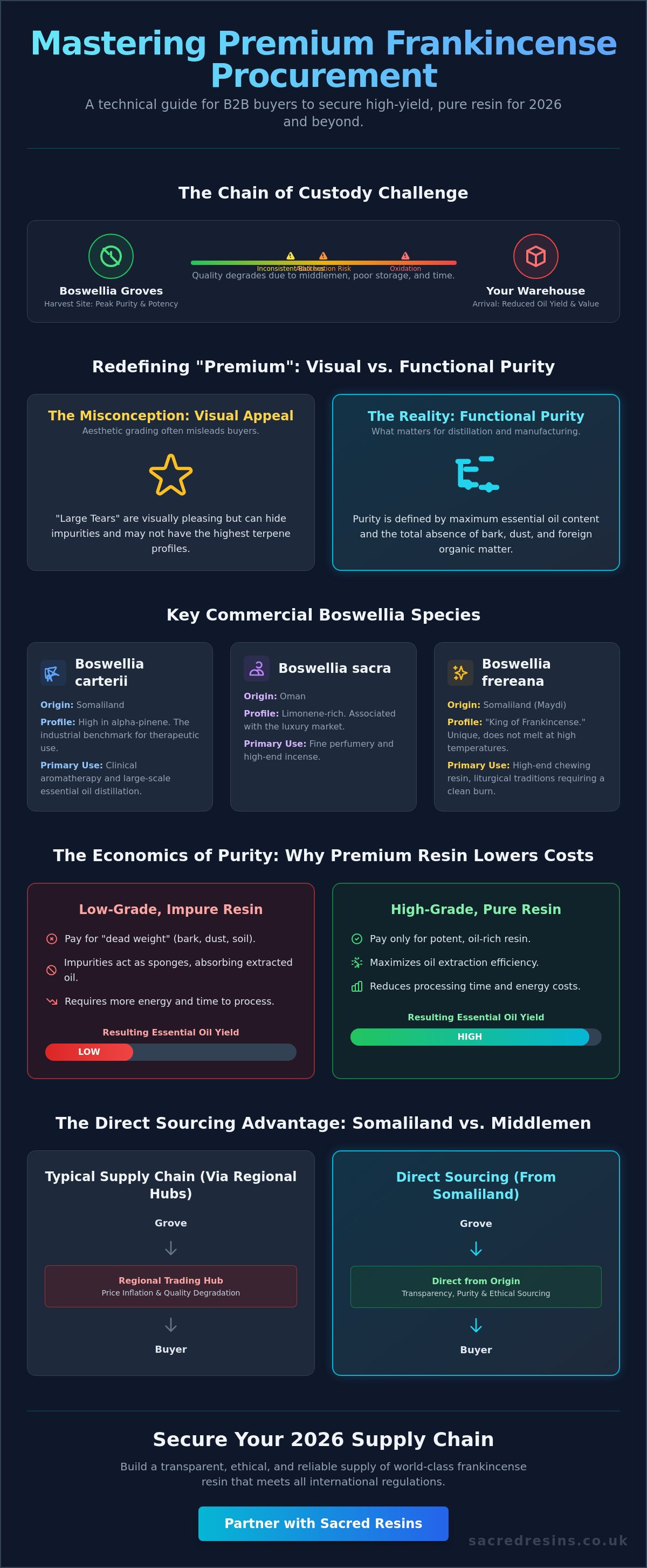
- Boswellia carterii (Somaliland): The industrial benchmark for therapeutic use. It's prized for its high alpha-pinene content, making it the preferred choice for clinical aromatherapy and large-scale essential oil distillation.
- Boswellia sacra (Oman): Often associated with the luxury market. It features a limonene-rich profile that lends itself to fine perfumery and high-end incense.
- Boswellia frereana (Maydi): Known as the "King of Frankincense," this Somaliland native is unique because it doesn't melt in high temperatures. It's primarily used for high-end chewing or specific liturgical traditions where a steady, clean burn is required.
Visual vs. Chemical Purity
There's a common misconception that "Large Tears" automatically equate to higher quality. While large, uniform tears are aesthetically pleasing for retail display, they don't always possess the highest terpene profiles. In a manufacturing context, functional grading is more important than visual appeal. A batch of smaller, well-sorted tears often provides a better oil yield than large tears that have trapped bark or soil within the resin as it dried.
Sorting is the most labor-intensive part of the supply chain. Premium batches must be meticulously cleaned to remove "siftings" (dust-sized particles) and larger pieces of bark. Resin purity is strictly defined by the total absence of foreign organic matter, including bark, sand, and non-resinous plant debris. Distillers shouldn't pay for the weight of the bark; they should pay for the potency of the resin.
The Botanical Science: Why Purity Dictates Distillation Yields
For essential oil manufacturers, the value of a shipment is found in the volatile oil percentage rather than the gross weight of the bag. Freshness is the primary driver of this metric. As resin ages, the volatile compounds, specifically the monoterpenes like alpha-pinene and limonene, begin to evaporate or oxidize. This degradation directly reduces the therapeutic potency and the aromatic profile of the final extract. Professional buyers look for specific chemical markers to verify species and quality; for example, high alpha-pinene levels in Boswellia carterii indicate a healthy, properly harvested tree. High-quality premium frankincense resin should ideally possess a vibrant, translucent appearance, which often correlates with a higher concentration of these essential compounds.
Distillers often hesitate at the higher price point of premium frankincense resin, but a technical analysis of ROI proves it's the more economical choice. When you source low-grade resin filled with bark and dust, you're paying for weight that yields zero oil. Worse, these impurities act as sponges during steam distillation, absorbing the very oil you're trying to extract. This results in a "dead" weight that requires more energy to heat and more time to process, without any corresponding increase in output. It's a hidden cost that erodes profit margins across the entire production cycle.
Maximizing Essential Oil Yield
The purity of the raw material determines the efficiency of your distillation cycle. High-grade resins with minimal foreign organic matter allow for better steam penetration and more consistent heat distribution within the retort. Adulterated batches containing fillers or excessive bark can cause "hot spots" or lead to the buildup of carbonized residue, which damages expensive equipment over time. Calculating your return on investment should focus on the cost per kilogram of finished oil, not the cost per kilogram of raw resin. A slight increase in initial material cost often results in a significantly higher oil yield, effectively lowering your total production costs. It's a matter of functional efficiency over superficial savings.
Storage and Preservation of Volatile Compounds
Once you've secured high-quality resin, preservation becomes the next logistical hurdle. Bulk shipments are susceptible to "blocking," a process where resins melt together into a solid mass due to heat or pressure. This makes the material difficult to process and can lead to uneven distillation. Oxidation is another silent thief of quality; exposure to air quickly alters the delicate chemical balance of premium grades. This is why sourcing fresh resin through direct channels is vital. Rapid processing and climate-aware shipping from Hargeisa ensure the material arrives with its volatile profile intact. Proper storage in cool, airtight environments will extend the shelf life of your inventory, protecting the integrity of your resin until the moment it enters the retort. Moisture content must also be monitored; resin that is too damp can develop mold in transit, while resin that is too dry has likely already lost its most valuable aromatic components.
Somaliland Sourcing vs. Global Middlemen: The Direct Advantage
Somaliland stands as the undisputed global epicenter for high-grade Boswellia carterii, yet much of the global market remains obscured by complex layers of intermediaries. When a buyer procures resin through regional trading hubs rather than at the source, they encounter what industry veterans call the "Middleman Tax." This isn't merely a financial markup. It represents a tangible decline in quality as batches from different regions are mixed, older stock is blended with fresh harvests, and the "Chain of Custody" is broken. To secure premium frankincense resin that meets the rigorous standards of 2026, professional buyers must look past these traditional hubs and establish direct links to the harvesting highlands of Somaliland.
Direct sourcing provides a level of transparency that intermediaries cannot match. It allows for the verification of ethical labor practices, which has become a critical legal requirement following the U.S. Customs and Border Protection's 2024 Withhold Release Order on certain Somaliland suppliers. By maintaining a direct relationship with the source, you ensure your supply chain is free from forced labor and that the harvesters receive a fair-trade price. This integrity doesn't just satisfy regulatory compliance; it builds a story of reliability and responsibility that resonates with the modern, conscious consumer.
The Hargeisa Supply Chain
The journey of high-grade resin begins in the remote highlands of the Sanaag region, but its quality is preserved in Hargeisa. Because Sacred Resins operates in close proximity to these harvesting sites, the time between the tree's "tears" hardening and the final packaging is significantly reduced. In our Hargeisa facility, the sorting process is handled by specialists who distinguish between grades based on purity and oil potential. This local processing ensures that the premium frankincense resin you receive hasn't spent months sitting in a humid port or a non-climate-controlled warehouse in a third-party country. We act as the necessary bridge, providing the logistical precision required for global B2B delivery while keeping the product's botanical integrity intact.
Ethical Stewardship and Sustainability
The long-term stability of the frankincense market depends entirely on the health of the Boswellia forests. Over-harvesting, driven by the aggressive demands of global middlemen, can lead to tree exhaustion and eventual population collapse. We implement sustainable harvesting cycles that allow trees to rest and recover between tappings. This stewardship ensures a consistent yield for decades to come rather than a quick profit today. Supporting these local communities through fair pricing creates an ecosystem where the harvesters are invested in the survival of the trees, protecting the heritage and the future of this ancient trade.
How to Evaluate Resin Grades for Bulk Procurement
Evaluating a bulk shipment requires more than a cursory glance at the top of a sack. To ensure you're receiving premium frankincense resin, you must apply a rigorous 5-step framework that moves from sensory observation to chemical verification. First, perform a visual consistency check across the entire batch to ensure uniformity. Second, use the "Squeeze Test" to assess moisture and freshness; high-quality resin should feel firm yet slightly yielding under pressure, whereas overly brittle tears suggest old stock that has lost its volatile oil content. Third, conduct an aromatic test by crushing a few tears to release the characteristic "clean" citrus and pine notes of Boswellia. Fourth, execute physical purity tests such as the Burn Test. Finally, verify the batch against a Certificate of Analysis (CoA) to confirm essential chemical markers like alpha-pinene or limonene levels.
Adulteration remains a sophisticated challenge in the wholesale market. Lower-grade shipments are frequently "bulked" with cheaper substances like gum arabic or even lower-quality myrrh to increase weight. While gum arabic is a natural plant resin, it lacks the aromatic compounds of frankincense and will fail to dissolve in the alcohols or oils used by distillers. Identifying these fillers early prevents the degradation of your final product. We strongly advise using small sample batches for laboratory testing before committing to large-scale procurement to ensure the material aligns with your specific technical requirements.
Visual Inspection Checklist
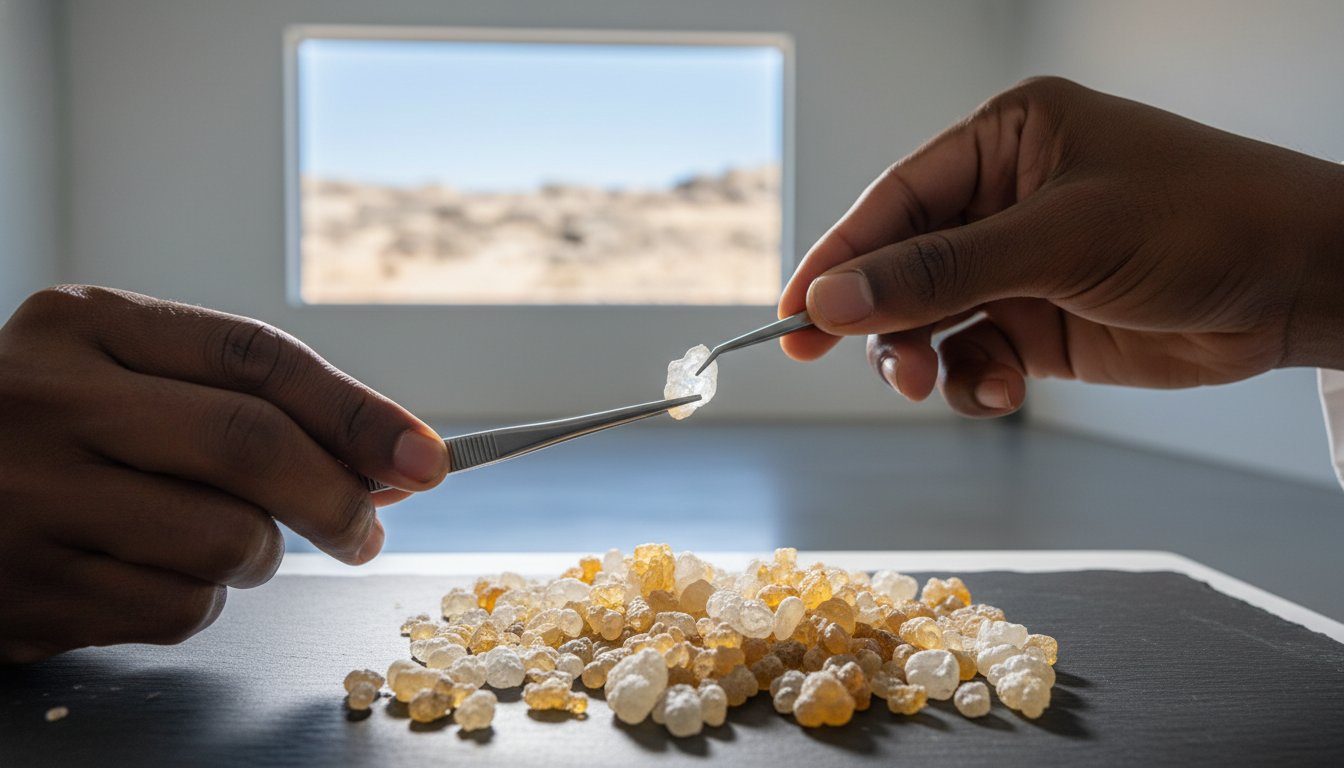
Consistency in color provides the first clue to a batch’s quality. Boswellia carterii typically presents as pale yellow to amber, while Boswellia frereana often shows deeper golden, translucent hues. Beyond color, you must quantify the presence of "siftings" and dust. In a premium wholesale batch, dust and small particles should constitute less than 5% of the total weight. Excessive bark inclusions are another red flag; these organic fragments don't just add dead weight but can also impart bitter, burnt notes to the oil during the distillation process.
Testing for Purity and Adulteration
The "Burn Test" is an effective field method for verifying purity. When placed on a hot coal, pure resin should melt completely and produce clean, white smoke without leaving a heavy, black residue. Dark smoke or a plastic-like scent indicates the presence of synthetic fragrances or heavy oil adulterants. For industrial users, solubility tests are equally vital. Pure frankincense resin should dissolve almost entirely in high-proof ethanol, leaving only minimal plant fiber. If you find significant insoluble matter, the batch likely contains gum-based fillers. To secure a supply that passes every professional test, you can view our current inventory of certified resins which are sorted and verified at our Hargeisa facility.
Scaling Your Supply: Why Sacred Resins is the Trusted B2B Partner
Moving from technical evaluation to large-scale procurement requires a partner who manages the complexities of the Horn of Africa supply chain with precision. Sacred Resins serves as this direct link, providing a streamlined path for businesses to acquire premium frankincense resin and myrrh without the interference of global middlemen. By consolidating your procurement of both Premium Frankincense Resin (Bulk) and Premium Myrrh Resin (Bulk), you reduce the administrative burden of managing multiple export permits and shipping manifests. This unified approach is particularly beneficial for wellness brands and liturgical institutions that require consistent, high-volume shipments to maintain their production schedules and product quality.
The reliability of your supply chain is as important as the resin itself. Sourcing from a single, direct supplier ensures that the chemical profile of your materials remains consistent from batch to batch. This stability allows your manufacturing processes to stay optimized for specific yields, as you aren't constantly adjusting your equipment for the variations found in mixed-source shipments. Our commitment to transparency means you have full visibility into the origin of your goods, supporting your brand's own ethical and sustainability claims in an increasingly regulated global market.
Wholesale Logistics and Global Shipping
Managing international exports from Somaliland involves meticulous attention to regulatory detail. We handle all necessary documentation, including phytosanitary certificates and certificates of origin, to ensure your cargo passes through global customs without delay. Typical lead times for bulk orders vary based on the seasonal harvest cycle, so we encourage buyers to plan their procurement in alignment with the natural tapping periods. Our packaging standards are designed specifically for the professional market, utilizing moisture-resistant, reinforced materials that prevent the resin from clumping or melting during the long-haul transit from Hargeisa to your facility.
Custom Solutions for Industrial Clients
Every industrial client has unique requirements for resin purity and chemical composition. Whether you're a distiller focused on high volatile oil yields or a religious organization seeking the clean burn of liturgical-grade tears, we provide tailored sorting to meet those specific needs. Our status as a privately owned supplier with deep roots in local harvesting communities allows us to offer a level of reliability that third-party resellers cannot match. This direct oversight ensures that the integrity of the resin is maintained from the moment it leaves the tree until it reaches your warehouse. If you're ready to secure your supply chain for the coming year, you can Enquire about bulk frankincense resin pricing for your business through our professional procurement portal.
Securing a Transparent Supply for 2026
Professional procurement in the coming year requires a shift from simple transactions to strategic partnerships. Success in this specialized market depends on recognizing that botanical purity is the foundation of manufacturing efficiency and product integrity. By prioritizing a direct-from-source Somaliland supply chain, you eliminate the risks associated with regional middlemen. This approach ensures your materials are ethically harvested and fair-trade compliant, meeting the increasingly rigorous standards of global regulators and conscious consumers alike.
Maintaining the excellence of your output involves both rigorous physical evaluation and a commitment to transparent logistics. We provide the expertise and the direct link necessary to scale your operations with grounded confidence. Our facility manages the complexities of worldwide B2B shipping from Hargeisa, ensuring your premium frankincense resin arrives with its volatile profile fully intact. You've now seen how the right sourcing strategy transforms a raw commodity into a reliable business asset.
Request a Wholesale Quote for Premium Frankincense Resin
We look forward to building a long-term relationship that respects the ancient heritage of these resins while serving your modern commercial needs.
Frequently Asked Questions
What is the difference between Boswellia carterii and Boswellia sacra?
Boswellia carterii and Boswellia sacra differ primarily in their geographic origin and chemical composition. Carterii is native to the highlands of Somaliland and is the industrial benchmark for therapeutic use due to its high alpha-pinene levels. Sacra is typically sourced from Oman and is favored in luxury perfumery for its limonene-rich, citrus-forward aromatic profile. Both are considered high-grade, but carterii is often the preferred choice for clinical aromatherapy and large-scale essential oil production.
How can I tell if my bulk frankincense resin is pure?
Verifying the purity of premium frankincense resin requires a combination of sensory and physical tests. A "Burn Test" is the most reliable field method; pure resin should melt completely and release clean, white smoke without leaving black, charred residue. You can also perform a solubility test by placing the resin in high-proof ethanol, where it should dissolve almost entirely. If significant insoluble matter remains, the batch may be adulterated with cheaper gums like gum arabic or excessive bark.
Why is direct sourcing from Somaliland better than buying from a regional hub?
Direct sourcing eliminates the quality degradation and price inflation that occurs when resin moves through multiple intermediaries. Regional hubs often blend batches from different regions or harvest years, which dilutes the chemical potency and breaks the chain of custody. By establishing a direct link to the source, you ensure the resin is fresh, unadulterated, and ethically tracked. This transparency is vital for meeting modern B2B compliance standards and securing a consistent, high-grade supply.
What is the shelf life of premium frankincense resin in bulk storage?
High-grade resin typically maintains its peak chemical and aromatic properties for one to two years when stored correctly. To prevent the evaporation of volatile oil compounds, you must keep the resin in airtight containers in a cool, dark, and dry environment. Over time, even premium frankincense resin will naturally oxidize and become more brittle. This process gradually reduces the essential oil yield, making freshness a critical factor for professional distillers.
Does the color of the resin indicate its quality or oil content?
Color is an indicator of the botanical variety and harvesting timing rather than a direct measure of essential oil content. While lighter, translucent tears are often graded higher for aesthetic or liturgical use, darker resins can still possess high terpene levels if they are fresh and well-sorted. Translucency is generally a more reliable indicator of quality than specific hue, as it suggests the resin hasn't been heavily oxidized or contaminated with internal bark inclusions during the drying process.
Can I use premium frankincense resin for essential oil distillation?
Yes, the primary industrial application for high-grade resin is steam or hydro-distillation. Because premium grades contain minimal bark and foreign organic matter, they provide a significantly higher oil yield than lower-grade siftings or adulterated batches. Using pure resin also protects your distillation equipment from the sticky, carbonized buildup caused by the high sugar content found in common fillers like gum arabic. It's the most cost-effective choice for maximizing production efficiency.
What are the minimum order quantities for wholesale frankincense?
As a dedicated B2B supplier, our minimum order quantities are structured to support the scaling needs of churches, wellness brands, and industrial manufacturers. While specific requirements can vary based on current harvest availability and the specific resin grade, we focus on wholesale volumes to ensure cost-effective international shipping. We recommend contacting our procurement team in Hargeisa to discuss the specific volume requirements and logistical arrangements for your business operations.
How does Sacred Resins ensure sustainable and ethical harvesting?
We ensure sustainability by implementing strict harvesting cycles that allow Boswellia trees to rest and regenerate between tappings. This practice prevents tree exhaustion and protects the long-term health of the Sanaag highlands. By paying fair-trade prices directly to our harvesting communities, we create an ethical economic environment where local families are incentivized to act as stewards of the forest. This direct relationship ensures the survival of the trees while maintaining a stable, high-quality supply for our clients.